
May 24, 2026
Blog
Why Your Front Desk Is Your Biggest Bottleneck Slug
Every service business has one. The role that quietly decides how much money the rest of the business can make. And almost nobody invests in it.
The most expensive role in a service business isn't the one you think.
It isn't the technicians. It isn't the sales team. It isn't even the owner.
It's the front desk.
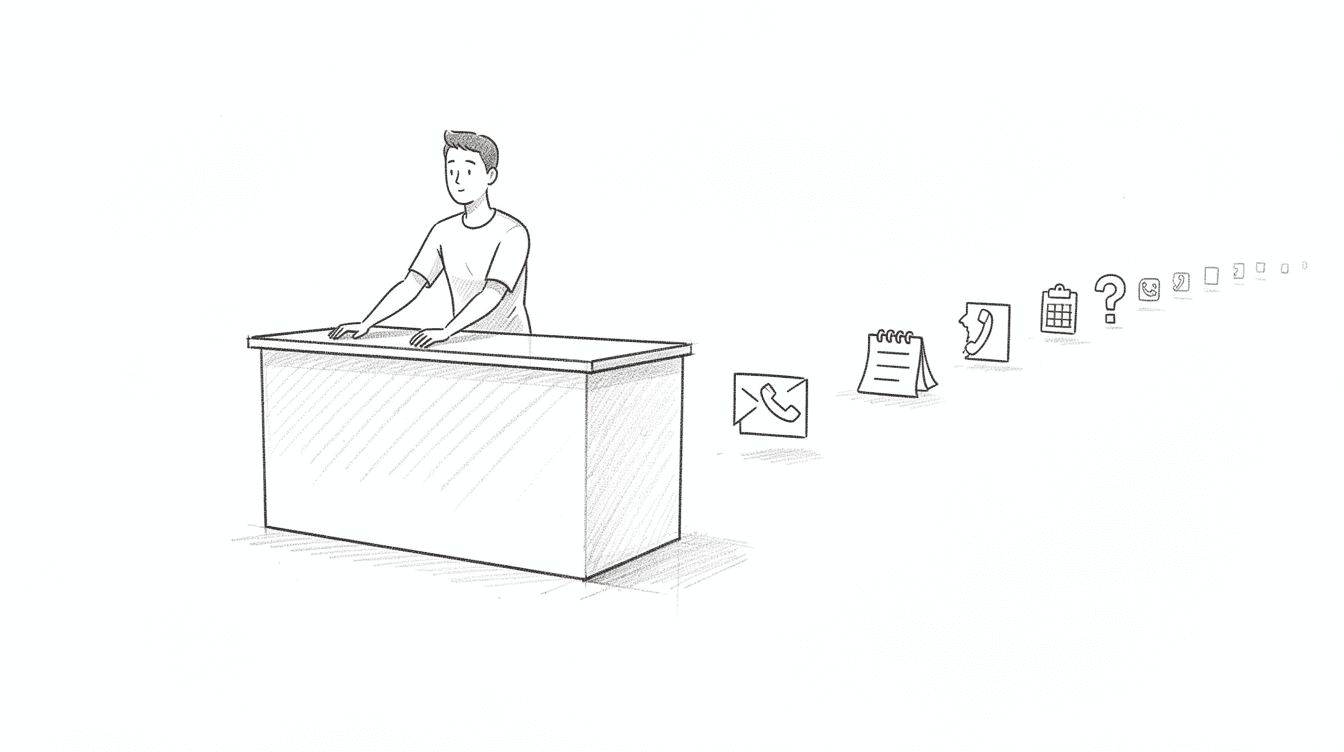
Not because of what you pay them. Because of what flows through them. Every lead. Every booking. Every cancellation. Every angry customer. Every quote follow-up. Every insurance call. Every "can you fit me in tomorrow." All of it lands on one or two people sitting at a phone and a computer.
When the front desk is overwhelmed, the whole business throttles down. And the front desk is almost always overwhelmed.
The math on the bottleneck
A typical small clinic or service business has one or two front desk people fielding 80 to 150 inbound interactions a day. Calls, walk-ins, emails, online forms, texts, scheduling changes.
Most of those interactions take 2 to 5 minutes if everything goes smoothly. They rarely go smoothly.
Now stack the day. Eight hours, two staff, three minutes per interaction. That's 320 interactions of capacity. The actual volume hits 250 to 300 on a busy day.
Sounds like it fits. It doesn't. Because the interactions don't arrive evenly. They cluster. Monday morning. Lunch hour. The hour after a marketing email goes out. Five minutes before close.
During those clusters, the front desk drowns. Calls go to voicemail. Emails sit unanswered. Walk-ins wait. Bookings don't get confirmed. New leads get back-burnered behind existing customer requests.
Every one of those delays is money walking out the door. And it's not the front desk's fault. They're doing one task at a time. There's just too many tasks.
The thing nobody wants to say out loud
Most service businesses know this is a problem. They just don't know what to do about it.
Hiring more front desk staff is expensive. A second full-timer is $40K to $55K a year all-in. And the problem isn't really headcount, it's the shape of the work. Half of what the front desk does could be handled by a system that doesn't take lunch and doesn't go home at 5pm.
The other half (the human conversations, the complicated situations, the emotional ones) is the actual job. That's where a real person belongs.
The problem isn't that front desk staff exist. It's that they're doing four jobs at once, and three of them shouldn't be human jobs at all.
What can actually come off their plate
Look at a typical front desk day. Break it into categories.
Repetitive inbound: hours, location, services offered, pricing questions, "are you taking new patients," "do you service my area." Caller doesn't need a human. They need a correct answer fast.
Booking and rescheduling: checking calendar availability, slotting a time, sending a confirmation, handling reschedules. Pure system work. The human doesn't add anything a calendar lookup couldn't do.
Reminders and follow-ups: appointment confirmations the day before, no-show recovery, post-service review requests, quote follow-ups. All scheduled. All scriptable. All currently eating staff time.
Lead intake and qualification: new leads come in, need to be captured, categorized, and routed. The capture and routing is automatable. The judgment call on a complicated lead is still human.
Now look at what's left. Walk-in interactions. Complicated insurance questions. Upset customers. Judgment calls on emergencies. Relationships with regulars.
That's the front desk job. The actual one. The one a person does well and a system can't.
The math problem isn't that the front desk is doing too much. It's that the front desk is doing the wrong things, and the right things are getting starved.
What the rebuild looks like
The shift isn't replacing the front desk. It's giving the front desk a layer underneath them.
AI voice agent handles the first ring on every call. Qualifies it. Books it if it's bookable. Transfers it to the human if it's not. The front desk only picks up the calls that actually need them.
Automated reminders run 24, 48, 72 hours before appointments. SMS confirmations go out without anyone typing. No-shows trigger an automated rebooking offer the same hour.
Lead capture pulls from every channel (web form, chat, voice, marketplace) into one queue. The front desk sees a single list, already categorized, instead of fishing through five tools.
The front desk role doesn't shrink. It changes. The person stops being a switchboard and starts being a problem-solver. The interactions they handle are higher value, more interesting, and they have time to actually do them well.
This is the part business owners miss. Automating around the front desk doesn't make the role smaller. It makes it possible.
The honest pitch
If your front desk is constantly behind, the answer is rarely "hire another one." The next one will also be constantly behind, just six months from now and with double the payroll cost.
The answer is cutting the volume hitting them. Most of the interactions piling up don't need a human in the first place. They need a system that handles the simple stuff and hands the complicated stuff up to the person.
Build that, and your front desk stops being your bottleneck. Don't, and the bottleneck just keeps getting more expensive.